Someone Else's Relationship Is Not the Blueprint for Yours
The Highlight Reel Is Not the Whole Movie
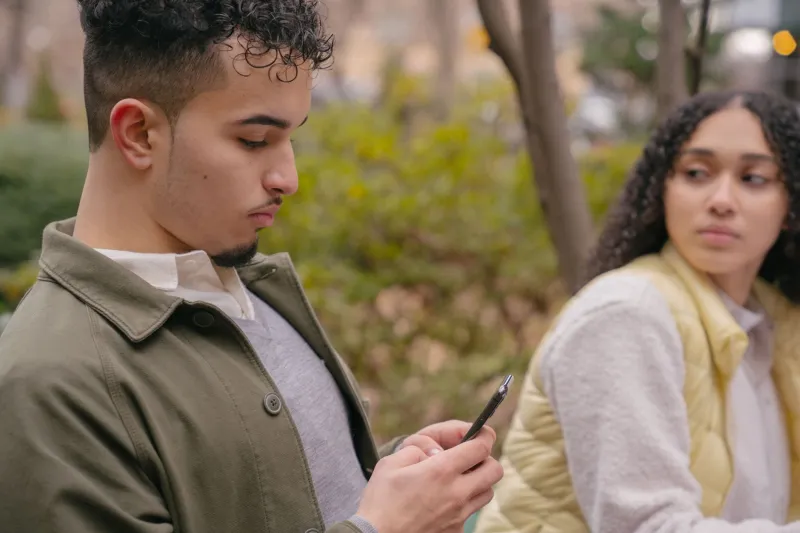
Your coworker just posted anniversary photos — a beach dinner, candles everywhere, a caption that reads "Five years and still my favorite person." Your friend group is buzzing about another couple who just bought a house together after eighteen months of dating. And meanwhile, you and your partner spent last Saturday arguing about whose turn it was to do laundry and then watched three hours of Netflix in total silence.
So naturally, your brain does what brains do: it compares.
And the moment it does, something quietly shifts. Your relationship — which was, by most honest measures, pretty good — suddenly starts to feel like it's falling short. Not because anything actually changed, but because you held it up next to someone else's curated version of love and found it lacking.
This is the comparison trap. And it's one of the most effective ways to slowly hollow out a perfectly solid relationship.
Why We Do It — And Why It's Getting Worse
Comparison isn't new. Humans have been sizing up their lives against their neighbors' since long before Instagram existed. But the scale of it now? That's unprecedented.
The average American spends close to seven hours a day looking at screens. A significant chunk of that time is spent watching other people's relationships — couples doing cute things on TikTok, engagement announcements on Facebook, wedding content that makes a Hallmark movie look understated. What we're consuming, almost constantly, is a stream of other people's best moments presented as their everyday reality.
The psychology here is pretty well understood. Social comparison theory — first laid out by psychologist Leon Festinger back in the 1950s — tells us that humans naturally evaluate themselves by looking at others. It's wired in. The problem is that our brains weren't built for a world where we'd be comparing ourselves to thousands of curated strangers every single day. We're running ancient software on a very modern problem.
And it's not just social media. Friend groups do it too. Family dinners where someone asks "So when are you two getting engaged?" carry their own kind of pressure. Movies and TV shows have spent decades selling us a very specific version of romance — grand gestures, perfect timing, a relationship arc that resolves cleanly by the third act. Real love rarely works that way, and yet those narratives get lodged somewhere deep and start functioning like a measuring stick.
What You're Actually Comparing
Here's the thing nobody tells you: when you compare your relationship to someone else's, you're not comparing two real things. You're comparing your full, unfiltered, behind-the-scenes experience — the disagreements, the boring Tuesdays, the moments where you both said the wrong thing — to someone else's edited trailer.
You don't see the couple from those beach photos when they're not speaking over a money disagreement. You don't know what goes on behind closed doors for the friends who seem so perfectly in sync. You're working with incomplete data, and you're using it to make sweeping judgments about your own life.
Even when comparison involves people you know well — close friends, siblings — you're still only seeing part of the picture. People share what they're proud of. They protect what's painful. That's human. But it means the benchmark you're measuring yourself against is, at best, partial and, at worst, completely fictional.
The Real Cost of Keeping Score
When you spend energy measuring your relationship against external standards, a few things start to happen — none of them good.
First, you stop appreciating what's actually there. Gratitude and comparison can't really coexist. When your attention is fixed on what you don't have, it becomes almost impossible to notice what you do. Small, genuine moments of connection — the inside jokes, the comfort of knowing someone really well, the quiet stability of trust built over time — start to feel invisible because they don't photograph well.
Second, you start putting pressure on your partner to perform. Instead of letting your relationship evolve organically, you begin nudging it toward some external ideal. You might push for milestones on someone else's timeline. You might get frustrated when your partner doesn't express love the way you've seen it expressed elsewhere. That pressure rarely brings out the best in either person.
And third — maybe most damaging — you start to feel like something is wrong with you. Like you're failing at love because your version of it looks different from the version being sold to you everywhere you look.
How to Actually Get Out of the Trap
The first step is just awareness. Notice when you're doing it. When you catch yourself thinking "Why don't we do things like that?" or "They seem so much more in love," pause. Recognize that thought for what it is: a comparison, not a fact.
From there, it helps to get specific about your own values. What do you actually want from a relationship — not what you've been told to want, not what looks good to other people, but what genuinely matters to you? Security? Adventure? Deep conversation? Physical affection? Shared goals? When you get clear on your own priorities, external benchmarks start to lose their grip because you have an internal compass to return to.
It also helps to practice what some therapists call relationship gratitude — deliberately noticing and naming the things that are working. Not in a toxic positivity way where you ignore real problems, but in a grounded, honest way. What does your partner do that makes your life better? What moments in your relationship have felt genuinely good? Anchoring yourself in those specifics pulls your attention back where it belongs.
And if social media is feeding the comparison spiral, it's okay to create some distance. Muting accounts, limiting screen time, or even just being more conscious about how you feel after you've been scrolling — these are small moves that can make a real difference over time.
Build Your Own Definition of Love
The most fulfilling relationships aren't the ones that look the best from the outside. They're the ones that work for the two people inside them.
Some couples thrive with a lot of independence and space. Others want to be joined at the hip. Some express love through words; others through acts of service or physical touch. Some relationships move fast; others take years to find their rhythm. None of these are wrong. They're just different — and the sooner you stop trying to make your relationship match someone else's template, the sooner you can start building something that actually fits.
Your relationship doesn't need to look like a good Instagram post. It needs to feel like a good life.
And that's a standard worth measuring up to.